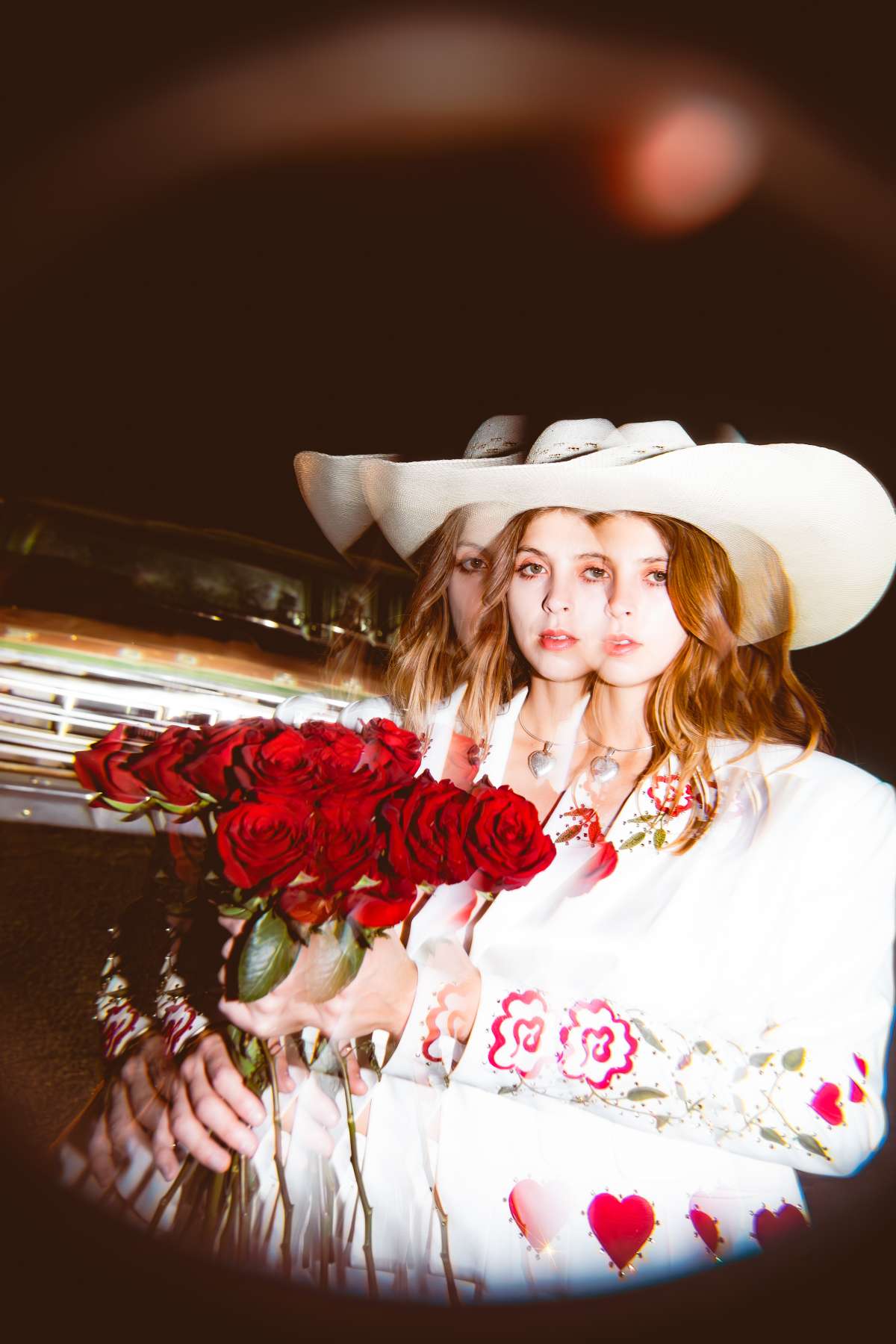
Every universe begins with a singular point, a quiet corner where instinct speaks loudest, where existential imagination can stretch its limbs. For acclaimed harpist and songwriter Mikaela Davis’ new album, Graceland Way (due TK via Kill Rock Stars), that singularity was a hillside home in Chevy Chase Canyon, a spot nestled in Los Angeles County where time slowed, the world fell away, and Davis could create from a sense of warmth and deep attentiveness. The “canyon country” epic born of that care ties a neo-western future back to the lineage of Laurel Canyon, the mythos of Elvis’s Graceland, and Paul Simon’s restless reinvention—a place where Davis can explore the fragile balance of light and dark, grace and struggle, rose and thorn, as well as the mystical power found at their nexus.
The record’s musical big bang originated at the nexus of UHF Studio, where Davis and noted guitarist John Lee Shannon, co-wrote the record and co-produced alongside longtime collaborator Dan Horne. As the album’s story of an unnamed antihero navigating life in a failing world, her harp, his guitar, and their joint melodies weave a mystic depth. That’s immediately evident from the opening track “(Looking Through) Rose Colored Glasses”, a harp glissando burst functioning like a blissful wormhole to a new universe where dark Western tones come aided by Kurt G. Johnson’s pedal steel guitar and transformative harmonies from guest vocalists Madison Cunningham and Tim Heidecker. But even in this pained origin story, Davis’ glittering, opalescent voice and evocative harp find a depth of beauty.
That duality is then immediately challenged in “Nothin’s On The Radio”, where the antihero arrives in a city devoid of meaning, the dystopia of modern homogenized radio writ large. “It already feels dystopic living in a world today where radio stations are all owned by a handful of corporations, all playing the same artists. Gone are the days when the radio was a way to bring people together, to amplify the voices of freaks and weirdos from all corners of the world,” she says. “I was fortunate to grow up in the last years of the golden age of FM radio, and being able to tune into this magical world far beyond my own was a transformative experience. Hearing artists like Sheryl Crow and Vanessa Carlton coming through the car stereo is what made me want to write songs and play music in the first place.”
As the album progresses and the story continues, Davis and her compatriots explore magic and mysticism on “11:11” and the haunting darkness of “Mizmoon”. Cass McCombs wrote the latter, rattling percussion and Davis’ harp low end giving way to slippery shadows of violin. “When Cass first sent over the track, it was the coolest thing I’d ever heard,” Davis says. “The music and lyrics create such an ominous mood and I could imagine how the harp would carry the song right away.” Elsewhere, Wednesday vocalist Karly Hartzman contributes to “Junk Love”, an exploration of knowingly filling an empty space with meaningless physicality. Across Graceland Way’s, Davis’ harp masterfully powers the wide variety of soundscapes, taking on an ecstatic range of emotional color. “At the end of the journey, the place you were destined for all along isn’t even a place, it’s a state of mind: Graceland Way,” Davis says. “It’s all interconnected and the universe balances itself. You need the dark to see the light, and the most beauty usually happens where the two meet.”